In April 2026, NASA's Curiosity rover dissolved a rock sample in a chemical solution and detected 21 distinct carbon-containing molecules — seven of them never before seen on planet Mars. Among them: benzothiophene, a two-ring organic compound that on Earth forms in the interstellar medium and on ancient meteorites. The ancient Mars, scientists now say, was not merely habitable. It was "amazingly habitable."
Mars has never been more fascinating — or more understood. This guide brings together everything we know in 2026: the planet's extreme geology, its watery past, the rovers that roam its surface today, and the mounting evidence that life may once have called it home.
Table of Contents
- What Is Mars? Core Facts About the Red Planet
- Mars's Record-Breaking Geological Features
- The Atmosphere, Climate, and Weather of Mars
- Water on Mars: From Ancient Oceans to Today's Ice
- The Search for Life: What 2026's Discoveries Reveal
- Mars Missions: From First Flybys to Today's Rovers
- The Race to Mars: Human Missions and What Comes Next
- Frequently Asked Questions
What Is Mars? Core Facts About the Red Planet
Planet Mars is the fourth planet from the Sun and the seventh largest in our solar system. With a radius of 3,390 kilometers (2,106 miles), it is roughly half the size of Earth and about 11% of Earth's mass.
Planet Mars orbits the Sun at an average distance of 228 million kilometers (142 million miles) — about 1.5 times farther from the Sun than Earth. A Martian day, called a sol, lasts 24 hours and 37 minutes, remarkably close to a day on Earth. A Martian year, however, lasts 687 Earth days — nearly two of our years.
Planet Mars has two small, irregularly shaped moons: Phobos and Deimos, named after the horses that pulled the chariot of the Greek war god Ares (Mars in Roman mythology). Phobos is slowly spiraling inward and will either crash into Mars or break apart in roughly 50 million years. Deimos, the smaller of the two, orbits at a safer and more stable distance.
 Mars captured from orbit by NASA's Viking orbiter. The dark Syrtis Major volcanic plateau is visible at center. Credit: NASA/JPL
Mars's Record-Breaking Geological Features
If Mars is defined by one quality beyond its color, it is extremes. The planet holds multiple solar system records for sheer geological scale.
Olympus Mons is the tallest volcano — and the tallest mountain — in the entire solar system. It stands approximately 25 kilometers high, nearly three times the height of Mount Everest, and stretches 600 kilometers across at its base, roughly the width of Italy. It is a shield volcano, shaped by gradual lava flows rather than explosive eruptions, comparable to the volcanoes of Hawaii but on an incomprehensible scale. NASA's Mars Odyssey orbiter captured a detailed thermal infrared portrait of Olympus Mons in March 2024.
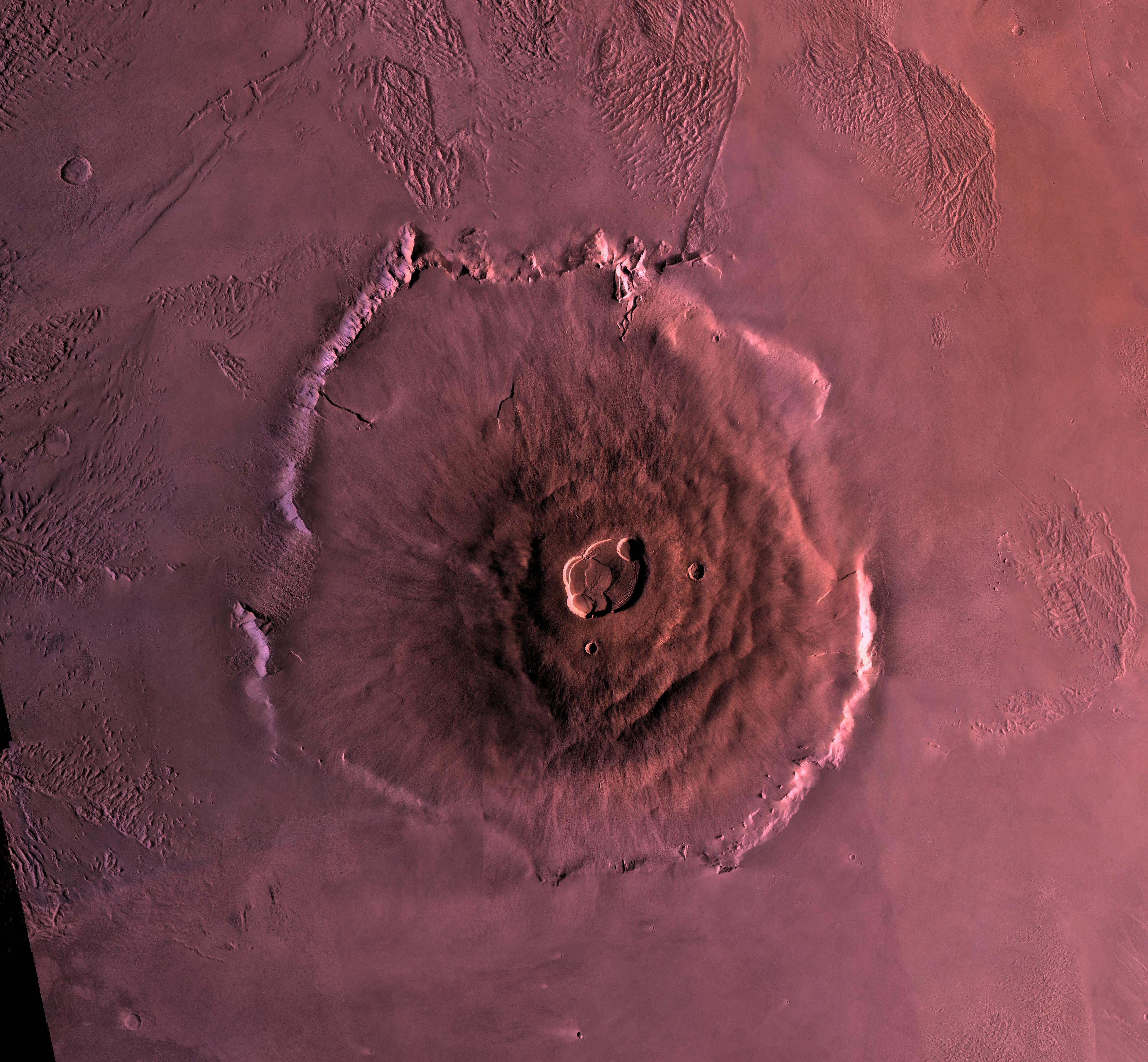 Olympus Mons — the solar system's largest volcano — imaged by NASA's 2001 Mars Odyssey orbiter. Credit: NASA/JPL-Caltech/ASU
Valles Marineris is the grandest canyon system in the solar system. It stretches over 4,000 kilometers — roughly the distance from Los Angeles to New York — and in places plunges 11 kilometers deep. That makes it 11 times longer and five times deeper than the Grand Canyon. It formed primarily through tectonic forces; ancient water flow and landslides later widened and deepened it.
Hellas Planitia, the planet's largest impact basin, spans 2,100 kilometers across and sinks more than 9 kilometers below the surrounding terrain. Its floor sits so deep that atmospheric pressure there is the highest anywhere on Mars — a geologically unique environment that scientists believe may once have hosted liquid water even as the rest of the planet froze.
The Atmosphere, Climate, and Weather of Mars
Planet Mars has a thin, cold, and dusty atmosphere composed of approximately 95% carbon dioxide, 2.6% nitrogen, and 1.9% argon. Total surface pressure is less than 1% of Earth's — roughly equivalent to the air pressure at 35 kilometers altitude above Earth. You could not breathe it, and you would require a pressurized suit and oxygen supply to survive even briefly on the surface.
Temperatures on planet Mars swing wildly with the seasons and latitude. On a summer afternoon near the equator, the surface can reach a relatively mild 20°C (68°F). At the polar regions in winter, it plummets to -153°C (-225°F). The global average hovers around -60°C (-80°F).
One of Mars's most dramatic weather events is the global dust storm. Roughly every few Martian years, dust storms can swell to engulf the entire planet for months, blocking sunlight and draining solar panels. It was exactly such a storm in 2018 that silenced NASA's Opportunity rover after 15 years of operation. Curiosity, powered by a nuclear battery, is immune to this risk — one key reason it is still exploring in 2026 after more than 13 years on the surface.
The sky on planet Mars is not blue. Suspended reddish dust particles scatter light differently than Earth's nitrogen-oxygen atmosphere, giving the Martian sky a butterscotch or pale pink tone during the day and turning blue briefly at sunrise and sunset — the exact reverse of Earth.
Water on Mars: From Ancient Oceans to Today's Ice
Water is the central story of planet Mars. Nearly every major discovery of the past two decades traces back to it — and in April 2026, that story gained a dramatic new chapter.
The "Bathtub Ring" Discovery
Researchers at Caltech, publishing in Nature in April 2026, identified a flat continental shelf zone wrapping around the Martian northern hemisphere. They describe it as a "bathtub ring" — just as a drained bathtub leaves a mineral ring marking where the water once stood, Mars appears to have left behind a coastal shelf hundreds of kilometers wide where an ancient ocean once met the land. Models suggest this ocean may have covered a third of the planet's surface and persisted for possibly millions of years — long enough to potentially support microbial life and leave behind biological signatures in the sediment.
The researchers also found that river deltas — sediment plains formed where rivers spill into bodies of water — align precisely with the coastal shelf, providing strong additional confirmation. The study was published April 15, 2026 in Nature.
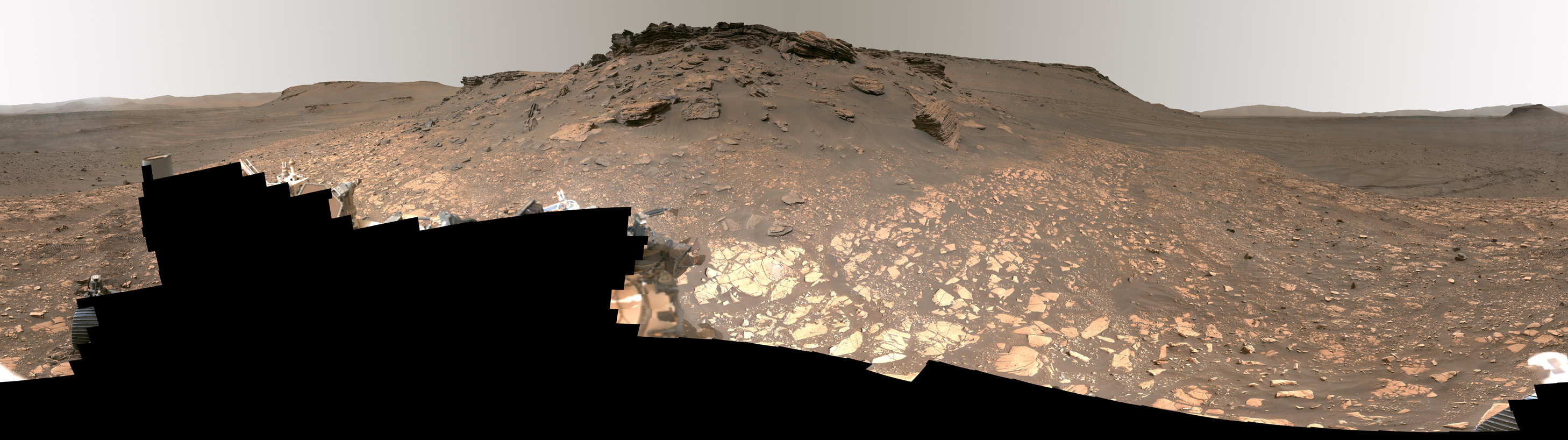 Perseverance's panoramic view of the ancient river delta in Jezero Crater, where water once flowed into a vast lake billions of years ago. Credit: NASA/JPL-Caltech/ASU/MSSS
Jezero Crater: A Lake That Once Was
NASA's Perseverance rover landed in Jezero Crater precisely because orbital images revealed it was once a lake fed by an ancient river delta. Rock and sediment analyses by Perseverance confirmed the crater held standing water for extended geological periods. In 2026, researchers also found evidence of wave-formed beaches and rocks altered by subsurface water, significantly extending the estimated timeline of habitability at this site.
Water on Mars Today
Liquid water cannot persist on the modern surface of planet Mars — the thin atmosphere causes it to evaporate almost instantly. However, water ice exists in abundance at both polar caps and just below the surface in mid-latitude regions. Scientists have also observed recurring slope lineae (RSL) — dark streaks that appear seasonally on crater walls — which may be caused by briny water seeping through the regolith. Confirming their true nature remains an active area of research.
The Search for Life: What 2026's Groundbreaking Discoveries Reveal
No Mars discovery in recent memory has generated more scientific excitement than the findings published on April 21, 2026 in Nature Communications.
NASA's Curiosity rover, using a first-of-its-kind wet chemistry experiment on Mars, dissolved a rock sample in a solution containing TMAH (tetramethylammonium hydroxide) — a compound designed to break apart large organic molecules for analysis. The rover's SAM (Sample Analysis at Mars) instrument then catalogued the fragments. The result: 21 distinct carbon-containing organic molecules, seven of which had never before been detected anywhere on planet Mars.
Among the newly identified compounds was benzothiophene — a two-ringed molecule containing carbon and sulfur that on Earth forms in ancient biological processes and in deep-space chemical environments. Researchers carefully stated that the origin of these molecules — biological, geological, or meteoritic — remains undetermined. But the implications are significant.
 NASA's Curiosity rover on the slopes of Mount Sharp inside Gale Crater — the site of the landmark April 2026 organic molecule discovery. Credit: NASA/JPL-Caltech/MSSS
"These findings are important because they confirm that larger complex organic matter is preserved on Mars over geologic time periods, despite the harsh radiation environment."
— University of Florida researcher, Nature Communications, April 2026
The 2026 results build on a series of earlier findings. In 2025, Perseverance detected vivianite and greigite within Jezero Crater rocks — two minerals that on Earth are closely associated with microbial activity in iron-rich environments. Neither discovery proves biology existed on Mars, but together they sketch a portrait of a planet that once had the chemistry, liquid water, thermal energy, and time to potentially support life.
To definitively answer the life question, Mars rock samples must be returned to Earth for laboratory analysis — which is exactly what ongoing and planned missions aim to achieve.
Mars Missions: From First Flybys to Today's Rovers
Planet Mars is the most extensively explored world in the solar system beyond Earth. More than 50 missions have been launched toward it since the 1960s, with roughly half achieving success.
The Key Milestones
The journey began with Mariner 4 in 1965, which captured the first close-up images of another planet — a cratered, apparently barren world. Viking 1 and 2 (1976) became the first spacecraft to land and operate on the Martian surface, running the first life-detection experiments. Scientists debated the ambiguous results then, and they debate them still today.
The modern era opened with Mars Pathfinder (1997) and its tiny Sojourner rover, then leaped forward with Spirit and Opportunity (both landed 2004). Opportunity survived for an extraordinary 15 years before a planet-wide dust storm ended its mission in 2018.
Curiosity landed on August 6, 2012 and is still fully operational. As of April 2026, it has been active for 4,875 Martian sols, driven over 32 kilometers, and drilled into 35 rocks to study their internal composition. Its most recent triumph — the April 2026 organic molecule discovery — generated global headlines and redefined scientific understanding of Mars's ancient habitability.
Perseverance landed on February 18, 2021, and represents the most advanced Mars rover ever built. As of April 2026, it has been operating for 1,837 sols, driven more than 30 kilometers across Jezero Crater, and collected 24 rock and regolith samples sealed in titanium tubes for eventual return to Earth.
 NASA's Perseverance rover on the surface of Jezero Crater. Its wheels left the first tracks on Martian soil in February 2021. Credit: NASA/JPL-Caltech
Perseverance also carried Ingenuity, a small experimental helicopter that completed 72 powered flights — the first controlled powered flights ever achieved on another planet. It flew for nearly three years before a rotor blade was damaged beyond repair in January 2024, ending its mission far beyond any original expectations.
Perhaps most practically significant for future human missions: Perseverance's MOXIE (Mars Oxygen In-Situ Resource Utilization Experiment) instrument produced approximately 122 grams of pure oxygen from the Martian CO₂ atmosphere across 16 experimental runs. This proof of concept demonstrates that future astronauts could manufacture breathable air and rocket propellant directly from the Martian atmosphere.
The Race to Mars: Human Missions and What Comes Next
The question is no longer whether humans will reach planet Mars — it is when, and which nation gets there first.
NASA targets a crewed Mars landing in the late 2030s to early 2040s. The agency's current strategy uses the Moon as a proving ground: Artemis missions establish sustained human presence in the lunar environment, where astronauts and engineers test the deep-space life support systems, landing technologies, and medical protocols that a Mars mission will demand. NASA has described a Mars landing by 2040 as "an audacious goal" — but one it is actively pursuing.
China has outlined the most concrete near-term timeline. The Tianwen-3 mission is scheduled to launch in 2028, deploy sample-collection robots on the Martian surface, and return those samples to Earth by 2031 — which would make China the first nation in history to achieve a Mars sample return mission. Chinese space authorities have stated intentions to land humans on Mars before 2050.
SpaceX once held the most aggressive timeline of all: Elon Musk envisioned sending cargo Starships toward Mars in the 2026 launch window, with crewed missions to follow. In February 2026, however, SpaceX officially delayed its Mars ambitions by five to seven years, redirecting Starship resources toward NASA's lunar Artemis contracts. Starship remains the leading candidate vehicle for an eventual Mars human mission — but timelines have shifted considerably from Musk's original vision.
The commercial opportunity behind Mars exploration is real and growing. The global Mars colonization market stood at $13.04 billion in 2025 and is projected to expand to $24.93 billion by 2030, reflecting a compound annual growth rate of 13.8%. Investment is flowing into AI-driven rover navigation (Perseverance now plans routes using onboard AI), in-situ resource utilization, radiation shielding, and closed-loop life support systems.
Conclusion
Planet Mars in 2026 is a world transformed — not physically, but in our understanding of it. We now know it once held a vast ocean. We know complex organic molecules survived billions of years of radiation locked inside its rocks. We know its volcanoes reached three times the height of Everest, its canyons dwarfed everything on Earth, and its ancient lakes preserved chemistry that may — may — hold the fingerprints of past life.
Four things stand out from everything science has learned about planet Mars: Mars was once a warm, wet world with the chemistry to support life; it preserved that chemical record in its geology across geological timescales; our current rovers are only beginning to read that record; and humans will eventually follow to study it directly.
To stay current on every new discovery, follow NASA's Mars Exploration website. For context on how planet Mars compares to other worlds, see our NASA Solar System Overview — the authoritative source for mission news, raw imagery, and scientific findings from every active mission at the Red Planet.
Mars is not simply a destination. It is the next chapter in the human story.
Frequently Asked Questions
Does Mars have water?
Mars has water in the form of ice at its polar caps and just beneath the surface at mid-latitudes. Liquid water cannot exist on the surface today due to the planet's thin atmosphere, but evidence — including the April 2026 "bathtub ring" discovery — strongly suggests vast liquid oceans covered a third of Mars billions of years ago.
What did NASA discover on Mars in 2026?
In April 2026, NASA's Curiosity rover detected 21 organic carbon-containing molecules never before seen on Mars, including benzothiophene — a compound associated with life's building blocks on Earth. Separately, Caltech scientists identified a "bathtub ring" coastal shelf in Mars's northern hemisphere as strong evidence of an ancient ocean that may have persisted for millions of years.
How long does it take to travel to Mars?
A one-way trip to Mars typically takes 7 to 9 months, depending on the specific trajectory and where the two planets are in their orbits. Launch windows open approximately every 26 months, when Earth and Mars reach their closest alignment.
Could Mars ever support human life?
Planet Mars presents extreme challenges: a thin, unbreathable CO₂ atmosphere, intense cosmic radiation, and an average surface temperature of -60°C. However, NASA targets a crewed landing by the late 2030s to early 2040s, and experiments like Perseverance's MOXIE — which produced oxygen from Martian air — are actively demonstrating that human survival on Mars is technically achievable.
Why is Mars called the Red Planet?
Mars owes its iconic color to iron oxide — rust — in its surface rocks, dust, and soil. When sunlight reflects off these reddish particles, the entire planet takes on a warm orange-red hue that is clearly visible to the naked eye from Earth, earning it the nickname "the Red Planet" since ancient times.